FB Group Posts: 5, 6 & 7 May 2021 – Banded Argillite, Trace Fossil Stones and Shades-of-Grey Quartzites

Three more of my recent regular Posts in the Facebook Group “New Zealand Lapidary, Rocks, Minerals, Fossils”. The first Post in this Series is here.

Wednesday 5 May 2021: Banded argillite stone from Gemstone Beach, size around 3.5 cms. Tumble-polished.

Argillite is a hardened, slightly recrystalised, mudstone, mainly grey through to black in colour but can also be green and red (arising from the presence of iron). Green is the most common colour for argillite on Gemstone Beach (with some having trace fossil burrows and trails in them) but some very nice grey banded stones can also be found. This particular stone is unusual as it has a subtle brown hue. Its “bands” or layers show signs of pressure deformation, with the beginnings of a stress fracture line apparent on one side. Tumble-polishing has smoothed the stone well and clarified its colours, though it has not taken a high polish.

Thursday 6 May 2021: In his book “Terrain: Travels Through A Deep Landscape” (2015), Geoff Chapple recalls a walk with the geologist Nick Mortimer along the Southland coast between Colac Bay/Oraka and Riverton/Aparima. On page 253 he writes: “We looked for the tattooed rock, the trace fossils that Maori call mokomoko, and it took some time but we did find them, wetting down the face of a rock layer to reveal 270 million-year-old traces of burrowing worms that took the purple of their starting layer down into the pale depths beneath, or dragged their pale layer into some purple darkness below, working their primitive palette, thousands of small finger painters out of the Permian…” These two tumble-polished trace fossil stones illustrate the dark in the light and the light in the dark (though there is little purple there).

The stones are mudstones, probably argillite, and the burrows and trails left in the ancient ocean floor sediment by these animals millions of years ago have been infilled by much finer sediment (silt?) of a different hue. The sediment has been compacted and cemented, producing this sedimentary rock and preserving the traces – further heat and pressure forms a different rock type (metamorphic) and destroys the traces. I have found such stones on Gemstone Beach and at Riverton/Aparima and, more recently, my wife found two at Whanganui, on South Beach, while riding her horse there. I treat such trace fossil stones lightly in the tumbling process (only one fine grit tumble before polishing) to preserve the traces, and they usually don’t polish highly. But tumbling removes the weathered outer layer and keeps the colours and patterns clear.

Friday 7 May 2021: These three tumble-polished stones come from Birdlings Flat having been collected there at various times over the past four to five years. They are examples of a type of quartzite to be found there, characterised by layers of shades of grey and white.

A quartzite starts off as a quartz-rich sandstone, a sedimentary rock that is grainy and feels like sandpaper. When the sandstone is exposed to high temperatures and pressures, the hard glassy metamorphic rock of quartzite is formed. Technically, more than 90% of the grains in a quartzite are quartz. Quartzite’s wide variety of colours (grey, red, green, yellow, and more) are a result of minor amounts of various minerals being incorporated with the quartz during the process of metamorphism. There are often tiny intricate veins of silica within quartzite stones, along with small clear crystal structures. Quartzites usually polish very well, due to their smoothness, hardness, and high levels of quartz, and their often complex patterns make them very attractive.

The next Post in this Series is here.

Thirty New Zealand TumbleStones for the USA – Part Three: Ten from Birdlings Flat

I recently received an email from Sheila in New Hampshire requesting some tumblestones that she could send to friends. I selected 30 polished stones from three South Island beaches to send to her. In Part One of this series of Posts, I described the ten I sent her from Gemstone Beach while Part Two described the ten from Kakanui. This Post describes the ten from Birdlings Flat.

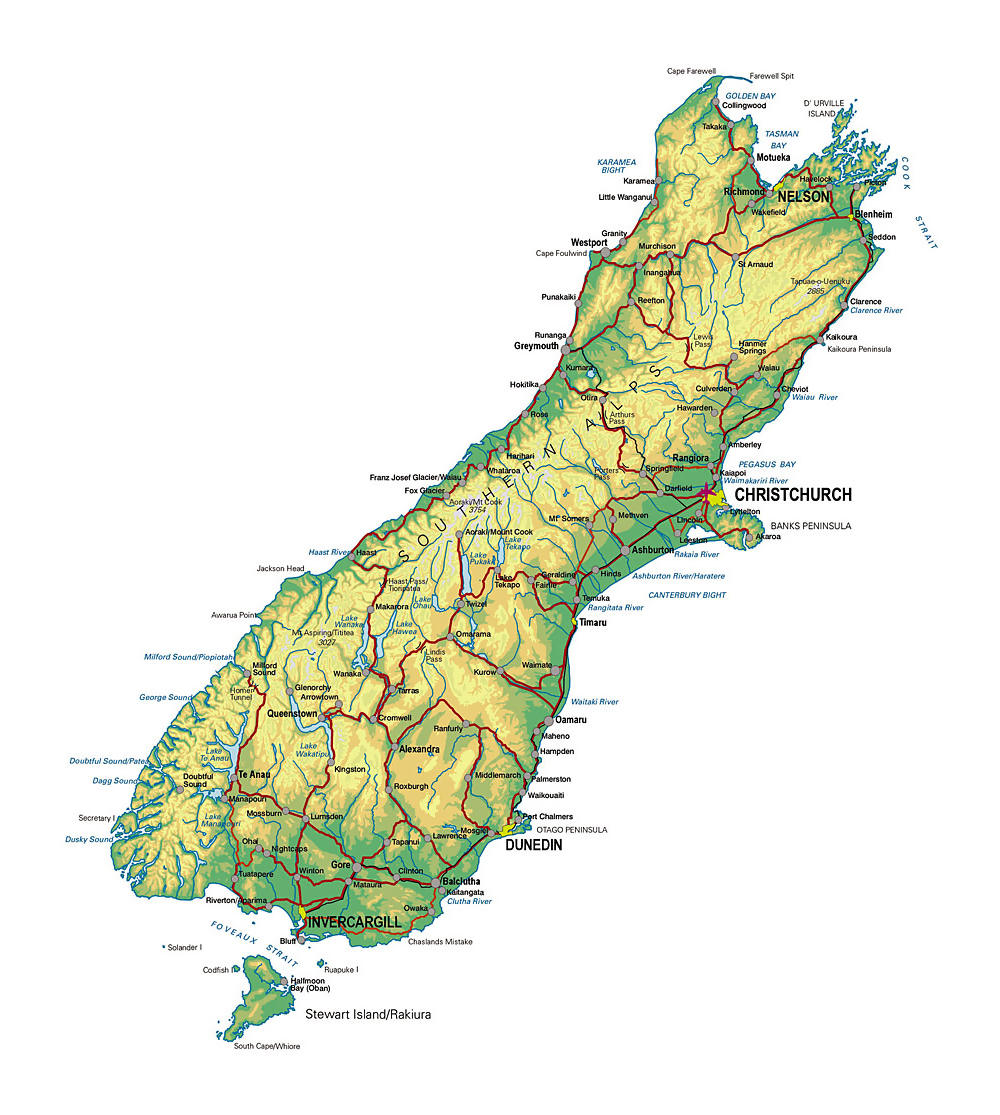
Birdlings Flat is a small village and beach just south of Banks Peninsula, half-way up the east coast of the South Island (see map below). The Peninsula is of volcanic origin but the Flat is located on the far eastern end of a large gravel spit called Kaitorete Spit.

Kaitorete Spit is about 25 kilometres long, cutting off a large lake from the sea:

Over a period of approximately 5000 years, Waihora/ Lake Ellesmere became first a bay, then an estuary and finally a lake, enclosed by the distinctive Kaitorete Spit, a long, narrow barrier of sand and shingle. The beach barrier, or ‘spit’ as it is known, is broadest and feels least exposed where it connects to the volcanic ‘mainland’ at the edge of Lake Forsyth. It tapers to a tenuous connection in the south where the lake is able to be artificially opened. (From “Banks Peninsula Landscape Study”, 2007, page 194.)

The beach at Birdlings Flat is perhaps the most well-known among stone fossickers in New Zealand. A great range of stones have been brought down to the sea from the Southern Alps by half-a-dozen rivers to the south, including stones from Kakanui (250 kilometres away) and even further south. For millions of years coastal currents have swept the stones north to pile against the basalt cliffs of the Banks Peninsula and to form Kaitorete Spit. In her book “The New Zealand Rockhound”, as long ago as 1981, Natalie Fernandez captures the character of the beach accurately when she wrote:

Hundreds of rockhounds have cut their teeth on Birdlings Beach – just a short run from Christchurch. Here great rollers break on the stony shore throwing forward stones with a roar as the waves thunder up the steeply shelving beach and sucking them back with a clatter as the waves recede. You can look for your agates and jaspers well back from the water-line but they do not show up clearly unless you dig down, for only the surface layer is dry. More exciting is to hunt along the water’s edge. As a wave slides back an agate is spotted. You leap for it but miss as the next wave roars in, driving you back. You never see that agate again. The beach is steep and the undertow strong. The breakers are especially powerful in a southerly and on the in-coming tide. Few can play this game and keep dry. (page 14)

Three videos on YouTube provide a good idea of the beach, its setting and its stones. The first one is nearly eight minutes of drone footage, showing the Birdlings Flat end of Kaitorete Spit. The second one provides a beach level view, just over one minute long, taken on a sunny day with a number of people enjoying the beach. The third one, 2 ½ minutes in duration, shows a stone fossicker hunting for beach agates.

I have visited Birdlings Flat three or four or more times a year since 2016, looking especially for agates and quartzites and jaspers but finding also a range of other interesting stones. I am sending ten of these stones to New Hampshire, some of them being nice quartzites. Here are the first five:

The second set of five stones from Birdlings Flat:

In the Introduction to Josie Iselin’s book of photos, “Beach Stones” (2006), Margaret Carruthers observes:

A beach is a strip of loose material at the water’s edge, a collection of sand and stones assembled, disassembled, and reassembled by the sea. On the geologic time scale, it is ephemeral. And for most stones, the beach is just the latest stop on a journey that began eons ago. (page 7)

For these 30 stones, the next stop on their journey lies across a great ocean and a great continent.

DELIVERY UP-DATE: I posted the stones on 1 December 2020. Sheila sent me a photo on 23 December (NZ time) showing they had been delivered! (It’s winter there, summer here.)

23 Dec received 1222201648b sml

POSTSCRIPT: Sheila kindly sent me a delightful book on New England’s stone walls – thank you!

Thirty New Zealand TumbleStones for the USA – Part Two: Ten from Kakanui

In Part One of this series of Posts, I explained how I received an email from Sheila in New Hampshire requesting some tumblestones that she could send to friends. I have selected 30 polished stones from three South Island beaches. Part One described the ten from Gemstone Beach. This Post describes the ten from Kakanui while the next Post describes the ten from Birdlings Flat.

Kakanui is a small town of just under 400 residents about 14 kilometres south of the city of Oamaru in North Otago in the South Island of New Zealand (see maps below). The Kakanui River and its estuary divide the township in two. There are a number of holiday homes there, especially south of the river, so the population increases particularly in summer. The Kakanui area contains a number of limestone formations which include many fossils. But it’s a small beach a couple of kilometres north of the town where I find the smooth beach stones that I tumble polish. The beach has no name, but I call it Seadown Beach after the road nearby.

The stones along this coast will have been brought down by rivers from the Southern Alps to the sea where they have been tumbled in the waves for many thousands of years.

The ten Kakanui tumblestones I sent to Sheila included quartzites and jaspers. Here are the first five stones:

Many of the stones on this beach in Kakanui are quartzites. A quartzite starts off as a quartz-rich sandstone, a sedimentary rock that is grainy and feels like sandpaper. When the sandstone is exposed to high temperatures and pressures, the hard glassy metamorphic rock of quartzite is formed. Quartzite’s wide variety of colours are a result of minor amounts of different minerals being incorporated with the quartz during the process of metamorphism.

Jasper is different from quartzite but is related, with quartz being the common denominator. Quartz is silicon dioxide (SiO2) and is the most abundant mineral found on the Earth’s surface. Jasper is an opaque form of chalcedony which is a cryptocrystalline form of silica. Chalcedony arises when quartz crystals forms at low temperatures in volcanic cavities. The crystals can be so small that they are visible only when magnified, which is the meaning of the term “cryptocrystalline”. Chalcedony comes in a vast array of colours and patterns which gives rise to a wide range of different stones. These include blood-red carnelian, wine-red jasper, brown-banded agate, green-moss agate, apple-green chrysoprase, and black and white onyx. The colour depends on what minerals seep into the rock. The presence of iron causes the red colour in jasper, but jasper can also be green, yellow and brown when other minerals are present instead.

It can often be difficult to decide whether some dark red stones are quartzite or jasper. Here are the second five Kakanui tumblestones sent to Sheila:

This YouTube video (below) is the view of the Kakanui area coast from a drone. The first part of it follows the coast southwards from Kakanui, with good views of the town just after the beginning. After 2 minutes 39 seconds, the video follows the old road which has been claimed by the sea’s eroding forces, travelling southwards towards Kakanui, finishing about a kilometre or two short of the beach that these stones come from.

The last Post in this series is on the ten tumblestones that come from further north, near Christchurch, from Birdlings Flat at the northern end of Kaitorete Spit.

“Golden” – A Wedding, Some Stones, and Harry Styles

“Loving you’s the antidote…You’re so golden” (Harry Styles, “Golden”)

Martina and Jules got married near Wellington on 24 September, high on a clifftop overlooking a wild sea. Martina is the daughter of my wife Petra. The wedding had been due to take place three months earlier but had to be postponed because of covid-19 pandemic restrictions. Martina and Jules asked me if I might be able to provide about 70 polished stones for the Reception. They would be used to hold down the pieces of card with people’s names on them that indicated their place at a table. A key colour for the wedding was gold so I went through my polished stones, looking for yellow, cream and light coloured ones of the appropriate size. I didn’t have enough so I included stones of other colours as well, sending about 90 in all, so that Martina and Jules could choose the ones they liked best.

Jules’s family have connections to Kakanui and I was able to provide a number of stones from there. Three other places were the source of most of the other stones – Birdlings Flat, Riverton and Gemstone Beach – with a few extras from places like the West Coast.

Wedding guests were able to take “their” stone home with them. A number of people commented on the stones, the interesting colours and the patterns in them. Below are photos of the stones on the name labels, and the two Riverton stones that sat upon the name cards of Petra and I.

I also gave Martina and Jules a personal gift of seven stones, posted to them after the wedding. I chose two of my favourite gold quartzites from Kakanui, representing male and female. There were also two stones from Gemstone Beach – a banded ignimbrite and a hydrogrossular garnet (with a light cloud of gold within). Over a year ago, I had shown Martina and Jules a number of polished stones and asked them which they liked best. Jules indicated the ignimbrite and Martina the garnet. So they now have these two. The other three stones are from Kakanui, including a cream-coloured fossil hash stone, a greyish quartzite and a stone with a delicate red-pink patterning.

The gold in many of these stones echoes the gold making up the wedding rings that Jules and Martina exchanged and now wear. Wedding rings, exchanged during the vows, symbolize the love and commitment to fidelity between two people. As a circle, a ring has no beginning or end, a symbol of enduring love. It is  worn on the fourth finger of the left hand because it was once believed that a vein connected this finger directly to the heart. Gold is a precious metal, shiny and lustrous, recognised as valuable since the most ancient of times, yet a gold ring is practical and hard wearing. The colour gold is the colour of success and achievement. Associated with abundance and prosperity, quality and sophistication, richness and warmth, it is also symbolic for the power of the sun, Earth’s life-giving star. Other associations with gold include wisdom, understanding and spirituality.

Harry Styles was a member of the British pop group One Direction before embarking on a solo career in 2016. One of the songs from his 2019 album “Fine Line” is “Golden”. While not directly addressing issues of weddings and wedding rings, nor gold-coloured quartzites (though love and a relationships figure promnently), “Golden” contains some themes that could perhaps be applicable (lyrics below). [For other TumbleStone Posts with music, see here.]

Golden, golden, golden
As I open my eyes
Hold it, focus, hoping
Take me back to the light
I know you were way too bright for me
I’m hopeless, broken
So you wait for me in the sky
Brown my skin just right
You’re so golden
You’re so golden
I’m out of my head
And I know that you’re scared
Because hearts get broken
I don’t wanna be alone
When it ends
Don’t wanna let you know
I don’t wanna be alone
But I can feel it take a hold
I can feel you take control
Of who I am and all I’ve ever known
Loving you’s the antidote
Golden
You’re so golden
I don’t wanna be alone
You’re so golden
You’re so golden
I’m out of my head
And I know that you’re scared
Because hearts get broken
…
I know that you’re scared
Because I’m so open
…

End of South Island Stone Collecting Trip, May/June 2020 – Days 19 to 22

The following are the last of my personal Facebook Posts on my trip, which were also posted in the Facebook Group “New Zealand Lapidary, Rocks, Minerals, Fossils”. The first five days of my trip can be found here.

Day Nineteen, Visit to Beaches North of Kakanui – I stopped off at about four places along the stony beaches just north of Kakanui. The bright sun dried out stones and made it hard to see their colours. 

But I managed to find a few worth tumble polishing, especially quartzites and some jaspers. I didn’t see any agates.

Day Twenty, Last Visit to Kakanui Beach on This Trip – I spent four hours on the stony beach two kilometres north of Kakanui. It was 1 degree when I arrived at 10 am, and it stayed cold. Hat, scarf, gloves and a thick coat were all necessities today. Today was cloudy, which meant that nearly all the stones on the beach stayed wet! That made fossicking so much easier than yesterday. I met a local couple walking their dog and picking up rubbish (bless them!). They told me that sometimes there are very few stones on the beach, and changes can occur from day to day. But today, they said, was excellent for someone like me. I found many very nice quartzites and red jaspers and a few other kinds of stones.

I stashed my finds in three different places as I made my way about a kilometre along the beach (it felt like two or three kilometres but I checked on Google Maps). I had to make sure I could remember these places so chose very large drift wood pieces. Gathering the stashes up on the way back made the last 300 metres an effort, but it was worth it. 

Day Twenty-One, Oamaru to Christchurch – Today I stopped off at Patiti Beach (Timaru), Browns Beach (near Temuka) and Wakanui Beach (to the east of Ashburton). The kind of stones I am interested in for tumble polishing are few and far between on these beaches but an hour’s fossicking does prove productive, especially for small quartzites and jaspers. 

Patiti Beach is located right within the boundaries of the city of Timaru:

Browns Beach is on the coast east of Temuka:

Wakanui Beach is east of Ashburton:

Day Twenty-Two, Final Day Visiting Beaches, Gore Bay and Kekerengu – I’ve now clocked up over 3,000 kms, reached Ward tonight, catching the Cook Strait ferry tomorrow (if it’s not too stormy). After leaving Christchurch this morning, I stopped off at Gore Bay, just to the east of Cheviot. Lots of grey stones on the beach, with the odd dash of white or colour. An hour’s fossick yielded a few interesting stones, often a bit bashed about.

Later I stopped off on the Kaikoura coast at the beach north of Kekerengu, not far from where the road leaves the coast to head to Ward. The sun was dropping but I wanted to revisit this beach – on my way south I had found some interesting limestone stones with trace fossils in them. I collected a few more to aid my study and understanding of them. Today was a warm day, up to 20 degrees. A storm is coming.

[The storm arrived the next day, the day I crossed Cook Strait on the car ferry. A planned trip to Ward Beach in the morning was not able to take place.]

South Island Stone Collecting Trip, May/June 2020 – Days 16 to 18

The following are Facebook Posts on my trip made for family and friends, as well as for the Facebook Group “New Zealand Lapidary, Rocks, Minerals, Fossils”. The first five days of my trip can be found here.

Day Sixteen, Ninth Visit to Gemstone Beach – Since I don’t leave Riverton until tomorrow, I decided to make one more visit to Gemstone Beach this morning, 30 kilometres away. The day was so nice and I had such a productive fossick yesterday that I couldn’t resist the temptation. Ended up spending nearly four hours in the sunshine.

Not as many great finds today compared to yesterday but I picked up some nice stones for tumble polishing. 

Met a couple of people on the beach, one from Montana and another from Riverton (who said she had learned tumble polishing from my Blog!), and had interesting chats about stones. 

Day Seventeen, Henderson Bay, Riverton – Had a quick visit to the bay in Riverton where I had summer holidays when growing up. It’s the last little bay before the Back Beach. 

Cold wind this morning so I needed all my warm weather gear. The stones at Henderson Bay are similar to those at the Back Beach and, to a lesser degree, Gemstone Beach. Generally speaking, there are fewer of them and of less quality here. 

Day Eighteen, Gore to Oamaru – I drove from Gore to Oamaru and stopped off at Hampden and the beaches between the Waianakarua River mouth and Kakanui. I decided that the stones on the beach just north of Kakanui were so great that I’ll be going back there again on Sunday and Monday. Cold but sunny weather, the lack of wind and rain is appreciated.

See here for the next Post in this Series.

South Island Stone Collecting Trip, May/June 2020 – First Five Days

On 14 May, New Zealand moved to Covid-19 Alert Level Two, lifting the majority of lockdown restrictions while maintaining physical distancing. It’s now been more than a week since New Zealand had a new Covid-19 case and there is currently only one active case left in the country. The move to Level Two means travel is now possible to different parts of the country. I have taken the opportunity to embark upon a three-week stone collecting trip to the South Island by car, crossing Cook Strait by ferry on Wednesday 27 May. The following are the up-dates I posted on Facebook for the first five days of the trip.

Day One, Wellington/Picton to Cheviot – Stopped on the beach some 60 kms north of Kaikoura and found lots of interesting white stones with dark shapes on them. Some of the shapes were very reminiscent of worm cast fossil traces – I will need to do a bit of research and sort out any connection. I found a few other types of stones as well. There were also lots of roadworks and seals along the coast.

[The stones are probably some kind of limestone and the dark shapes are definitely trace fossils. Whether they will polish or not is questionable due to the relative softness of the stones.]

Day Two, Cheviot to Birdlings Flat – Foggy this morning on the road for the first 30 minutes, sunshine the rest of the day though it struggled to get past 13 degrees. Some brilliant autumn foliage, especially in North Canterbury. I arrived at Birdlings Flat at noon, about 6 or 7 others collecting stones on the beach too. With the sun so bright and low in the sky, it was hard to pick out details of stones but I managed to find a few of interest, especially some nice quartzites. On the way to Christchurch for the night, saw some thick cloud clinging to the top of the Port Hills. Will visit Birdlings Flat again tomorrow.

[I found some typical Birdlings Flat stones with interesting colours and patterns.]

Day Three, Birdlings Flat – Cloudy and cool today, but the lack of sun meant that I could see the stones better. There was a 50 metre wide strip of wet stones along the shore-line which stayed wet, showing the colours of the stones. I walked up and down this strip, not along the beach – going towards the wave-line then back from it, zigzagging down the beach. 

In the three hours I was there, I found quite a few interesting stones, mainly quartzites, in a relatively small space (about 300 metres of the beach).

Day Four, Christchurch to Oamaru, Side Trip to Beach near Hinds – On my way to Oamaru, I turned eastwards at Hinds (100 kms south of Christchurch) to come out at the coast after about 20 kms just north of the Rangitata River mouth. It is said that stones brought down from the Alps by this river eventually make their way to Birdlings Flat (100 kms away). And the evidence supports that view. In the 90 minutes I was there, I collected a few quartzites of the type that can also be found at Birdlings, a few of which are quite stunning. There were quite a few jasper stones on the beach, and I found one small agate fragment.

Day Five, Oamaru to Gore, Side Trip to Beach near Kakanui – Just south of Oamaru I headed to the coast near Kakanui. My friend and former University of Waikato colleague David has a holiday home there and has encouraged me to see what stones might be found on the beach. I was very pleasantly surprised to find many nice quartzites there, especially the yellow/gold ones I particularly like. Another sunny day, cool, but excellent for fossicking mainly due to the lack of wind.

See here for the next Post in this Series.

Stay-at-Home Day Thirty, Friday 24 April 2020: Stone Thirty

Stone Thirty is another Birdlings Flat quartzite. 

I have found a number of these, with their typical white/light grey/dark grey/black layers and cloudy silica veins. 

They have become a favourite, and I always look out for them when I visit Birdlings Flat.

The next Post in this Series is Stay-at-Home Day Thirty-One, Saturday 25 April 2020: Stone Thirty-One. The first Post is Stay-at-Home Day One, Thursday 26 March 2020: Stone One. 

Stay-at-Home Day Twenty-Nine, Thursday 23 April 2020: Stone Twenty-Nine

Stone Twenty-Nine is another quartzite from Birdlings Flat. It finished the polishing process on 19 April, being in the same batch of stones as Stone Twenty-Seven. 

This is an example of a stone that has not polished perfectly. Along one edge it is rough, with some small holes. If I wanted to smooth those holes away, using the tumbling process, I would also smooth away a lot of the rest of the stone. The stone would shrink in size quite a bit, and we would lose a lot of the patterns we can see in it today.

The next Post in this Series is Stay-at-Home Day Thirty, Friday 24 April 2020: Stone Thirty. The first Post is Stay-at-Home Day One, Thursday 26 March 2020: Stone One. 

Stay-at-Home Day Twenty-Seven, Tuesday 21 April 2020: Stone Twenty-Seven

Yesterday, our Prime Minister Jacinda Ardern announced that the last day of Alert Level Four in New Zealand will be Monday 27 April. That means that Stone Thirty-Three will be the final one in this current “Stay-at-Home” series. New Zealand will then move to Alert Level Three, for an initial two weeks before review. This is still a very restricted Level – most people will still be staying-at-home, and businesses can operate only under strict social distancing rules. So I will run an Alert Level Three series of Stones of the Day during that period.

Stone Twenty-Seven is a dark red quartzite I found at Birdlings Flat, that I finished polishing two days ago.

There is an amazing complexity to its patterns of colours and lines.

As with many quartzites, there are “floating” patches of colour, and veins of clear or cloudy silica. Some of these veins appear to run through fault planes, where the stone has been subject to pressure and small movements. Some of the veins are very thin, others are thicker. 

It’s like looking down on the surface of a nearby planet.

The next Post in this Series is Stay-at-Home Day Twenty-Eight, Wednesday 22 April 2020: Stone Twenty-Eight. The first Post is Stay-at-Home Day One, Thursday 26 March 2020: Stone One.